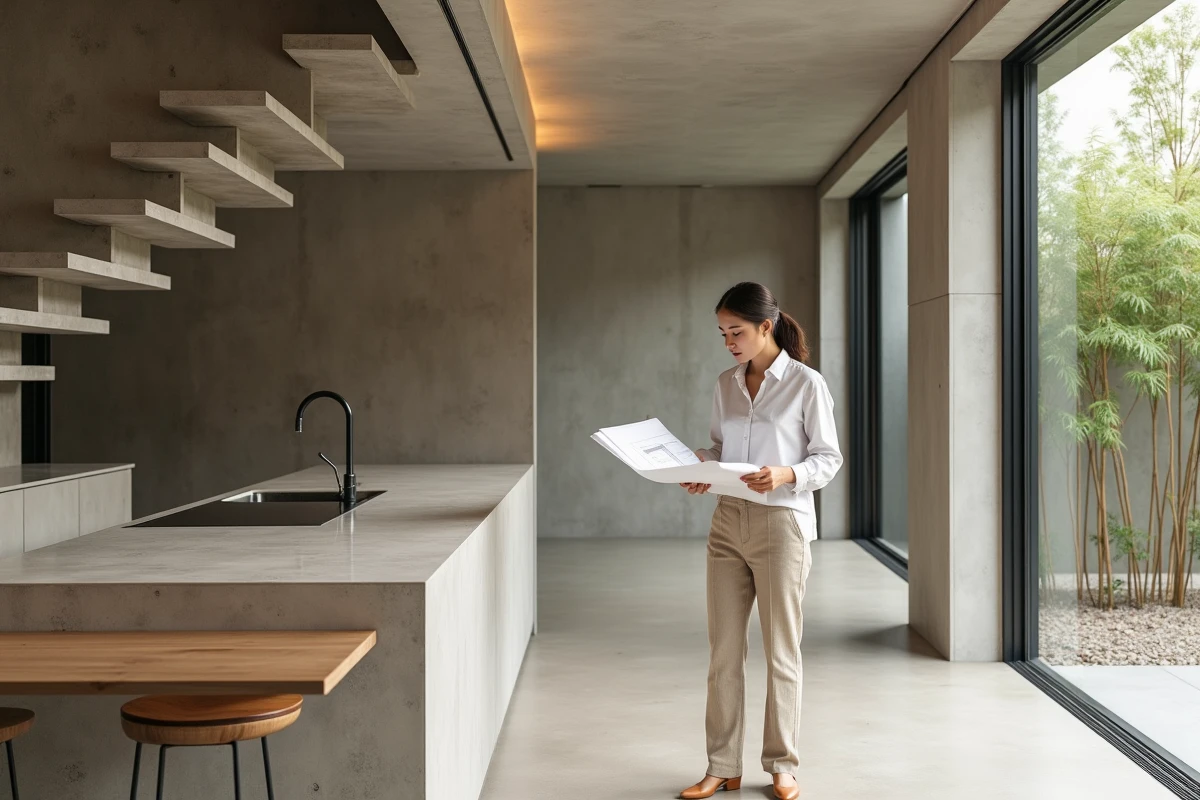
Contemporary architecture is no longer just a question of style or form. Constructive choices now involve regulated carbon assessments, post-occupancy evaluation protocols, and a return to minimally processed materials. Measuring these developments allows us to distinguish structural trends from fleeting fads.
Carbon performance and material choices: what regulations are changing
Several European countries have tightened their requirements regarding the carbon footprint of new buildings between 2022 and 2025. These regulations require justification of the building’s environmental impact over its entire life cycle, which directly alters the architectural choices made from the initial sketch.
Wood, rammed earth, solid stone, and straw are gaining ground against reinforced concrete and steel. This dynamic, referred to as the “low-tech turn” by the specialized press, is no longer a marginal experiment: it is found in emblematic projects across Europe, documented notably by The Architectural Review in 2023.
Agencies like those referenced on siaarchitecture.fr translate these regulatory constraints into design choices where material selection precedes facade design.
| Construction Approach | Preferred Materials | Impact on Design |
|---|---|---|
| Conventional (concrete, steel, glass) | Reinforced concrete, steel, aluminum, laminated glass | Large spans, curtain walls, free forms |
| Low-tech / bio-sourced | Solid wood, rammed earth, straw, cut stone | More compact volumes, visible wall thicknesses, raw textures |
| Hybrid | Wood structure + low-carbon concrete complement | Compromise between span/footprint, mix of finishes |
The shift from a “form then material” logic to a “carbon assessment then form” logic redistributes roles among architects, structural engineers, and construction economists. The resulting aesthetics – thick walls, exposed wooden joinery, mineral hues – is not a decorative choice but a direct consequence of a normative framework.

Post-occupancy evaluation: designing space based on resident feedback
For a long time, a completed building was seen as a finished project. Post-occupancy evaluation reverses this logic: standardized protocols measure actual comfort, space appropriation, and the impact on occupants’ mental health several months after delivery.
The Royal Institute of British Architects (RIBA) and the Building Performance Network have been documenting the generalization of this feedback since 2022. Initially limited to schools and hospitals, the practice is spreading to residential and high-end office spaces.
What user feedback concretely changes
The collected data feeds into databases used by architects to adjust their future projects. Corrections focus on specific points:
- The position and size of openings, often undersized compared to the actual need for natural ventilation felt by occupants
- The acoustic treatment of open spaces, where the promise of conviviality clashes with measured sound fatigue after a few months of use
- Natural lighting in living areas, whose perceived intensity differs significantly from digital simulations conducted during the design phase
Contemporary architecture now incorporates user experience as a project data, alongside functional programming or budget considerations. This feedback loop transforms the relationship between the client, architect, and resident.
Interior design and bioclimatic design: beyond decoration
Contemporary interior design increasingly borrows from bioclimatic principles. The arrangement of a space is not limited to color or furniture choices: it incorporates solar orientation, thermal inertia of walls, and natural air circulation.
In a house designed according to these principles, the rammed earth wall in the living room is not a decorative element. It is a hygrothermal regulator that absorbs excess moisture and releases it when the air dries out. The material serves a technical function before being an aesthetic choice.
Garden, terrace, and outdoor spaces as thermal extensions
The layout of the garden or terrace also contributes to the bioclimatic strategy. A deciduous tree planted to the south protects the facade in summer and allows light to pass through in winter. A green pergola reduces overheating on an exposed terrace without resorting to air conditioning.
These choices for outdoor arrangements, often perceived as landscaping, actually fall under the full definition of architecture. The company designing the building and the one designing the garden work on the same thermal system.
Bio-sourced materials and architectural modernity: a resolved contradiction
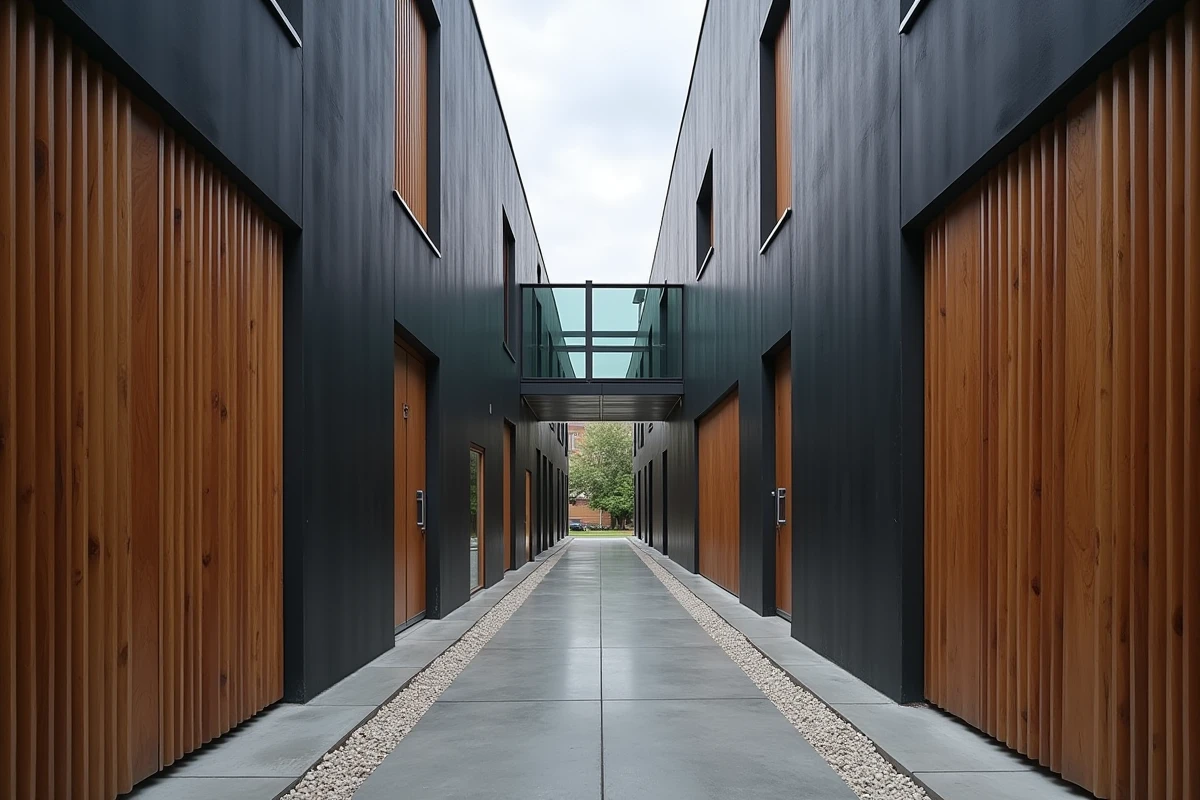
A common objection against bio-sourced materials concerns their compatibility with a modern aesthetic. Recent achievements prove otherwise. Cross-laminated timber (CLT) allows for spans comparable to those of concrete for multi-story buildings. Compressed earth can be finished smoothly or textured depending on the formwork used.
The contemporary architect has a broader palette of materials than ten years ago, provided they master the specific implementation constraints of each sector. The design of a solid stone facade does not follow the same rules as a glass curtain wall, but the result can be just as precise in its proportions.
- Solid or cross-laminated wood allows for tall structures with a reduced carbon footprint compared to steel
- Rammed earth (pisé, bauge, adobe) offers natural moisture regulation and a unique mineral aesthetic
- Straw, used as infill in wooden structures, achieves high thermal insulation performance at a low material cost
Architectural modernity is measured less by the transparency of facades than by a building’s ability to respond to the constraints of its time. Carbon regulations make bio-sourced materials not just alternatives but structural elements in the design of living, working, and leisure spaces. Contemporary architecture is redefined by what it builds, not just by what it designs.