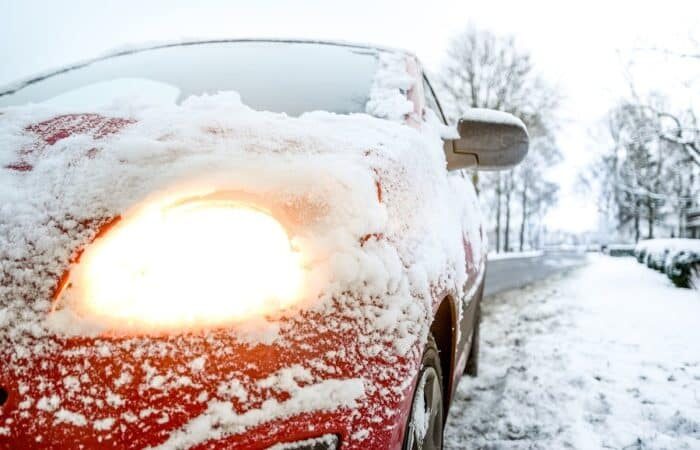
Winter brings a major challenge for drivers: driving on snow. Adjusting your speed is vital for maintaining safety on the road, especially when winter tires are involved. Although these tires are specifically designed to provide better grip on snowy and icy roads, the question remains about the optimal speed to maintain. You need to master winter driving, from the appropriate speed to potential hazards, to ensure a safe driving experience during the cold season.
Road Safety in Winter: The Importance of Winter Tires
Discovering the benefits of winter tires is a crucial step in understanding how to adjust your speed while driving in winter conditions. It’s also the way to provide a clear answer to the question many are asking: ‘Can you drive at 130 with winter tires?’.
Winter tires are specifically designed to offer better grip and optimal vehicle control on snowy or icy roads. Their unique structure, combined with a special rubber compound, significantly reduces the braking distance in these challenging conditions.
But then, can you drive at 130 with winter tires? Technically, some high-end models can handle this speed without issue. These tires feature a T rating that guarantees resistance up to nearly 190 km/h. However, this information does not automatically equate to a green light to maintain this pace throughout the winter.
In reality, even if technically ‘you can drive at 130 with winter tires’, you must always consider the current road conditions. In clear weather and on a clear road despite the cold, this might be feasible without major risk. However, as soon as ice or heavy snowfall covers the usual asphalt, caution should prevail, and you should lower your speed to avoid any potential loss of vehicle control.
Moreover, don’t forget that depending on the country you are driving in during this harsh period, certain specific rules regarding maximum speed limits may be in place.

The Advantages of Winter Tires: Increased Grip and Stability
The recommended speed limits when driving in winter with winter tires are essential to ensure your safety on snowy roads. In general, you should reduce your speed compared to usual limits when weather conditions are unfavorable.
In France, for example, the Highway Code states that the maximum speed limit on highways is generally set at 130 km/h. When there is snowfall or ice, it is strongly recommended to adjust your speed to these particular circumstances and to strictly adhere to the signs indicating a reduced limit.
In some European countries like Germany or Austria, where winter tires are mandatory during the winter season, there are also strictly defined rules regarding speed limits. For instance, in Germany, when driving with winter tires (identified by the ‘M S’ symbol) on a snowy or icy road, the maximum speed limit drops to 50 km/h on non-urban roads and varies between 60 and 100 km/h on certain sections of highways.
It is crucial to adopt a responsible driving style adapted to winter conditions. Winter tires are an undeniable asset for improving grip and road holding, but they should not be seen as a license to drive at excessive speeds in these delicate conditions. Adhering to the recommended speed limits will not only ensure your safety but also that of other road users who may also face the same difficulties.
Respecting Speed Limits in Winter: A Guarantee of Safety
When driving on snowy or icy roads, you must adopt a preventive approach. Here are some useful tips for adjusting your speed to winter conditions:
Anticipate turns: Reduce your speed before approaching a turn and avoid braking suddenly during the maneuver. Gradual deceleration will help you maintain control of your vehicle.
Maintain a safe distance: Increase the distance between you and the vehicle in front to have enough time to react if necessary. On snowy roads, this distance should be doubled compared to what is recommended in dry weather.
Avoid rapid accelerations: Sudden acceleration can lead to wheel spin and a loss of grip on the slippery road, compromising your stability.