
Public speaking is not just a matter of charisma or natural talent. It is a technical skill that relies on precise mechanisms of cognitive structuring, physiological stress management, and adaptation to the communication format. Since the rise of hybrid work, the demands have changed: video conference presentations and short formats impose constraints that traditional approaches do not cover.
Cognitive Load and Message Structure in Public Speaking
A speech that does not take into account the audience’s attention capacity misses its target, regardless of the speaker’s mastery of the subject. Recent research in cognitive psychology on attentional load shows that short, highly structured interventions significantly improve retention compared to long presentations.
We recommend limiting each intervention to three key points maximum per sequence. Several training organizations now advocate for speeches lasting three to seven minutes to maximize impact, except in specific cases. This framework is not a pedagogical gimmick: it corresponds to the optimal attention span documented in a hybrid meeting context.
Structuring a message into three points does not mean simplifying. It means prioritizing. The technique involves identifying a main message, two supporting arguments, and a concrete illustration for each argument. Each point should be understandable independently of the others, in case the audience loses focus on a part.
Many professionals prepare their content by starting with the introduction. We observe better results when preparing the conclusion first, then working back to the arguments. This forces clarification of the final message before constructing the path that leads to it, as detailed by jeanlouis-garret.fr in its resources on professional communication.
Managing Stage Fright with Cognitive-Behavioral Techniques
Public speaking training increasingly incorporates techniques from Cognitive Behavioral Therapy (CBT) and cardiac coherence. This shift is explained by a simple observation: purely technical approaches (voice, posture, gestures) are not sufficient for individuals prone to severe stage fright.
Cardiac coherence, in practice, involves synchronizing one’s breathing with a five-second inhale and a five-second exhale for three to five minutes before speaking. This protocol regulates the autonomic nervous system and reduces cortisol production.
Cognitive Restructuring Before a Presentation
Stage fright often stems from anticipated catastrophic scenarios: “I will lose my words,” “the audience will judge me incompetent.” CBT offers a process of restructuring negative automatic thoughts. Before each speaking engagement, we recommend a three-step exercise:
- Identify the specific automatic thought that generates anxiety, writing it down if possible
- Assess the actual probability of this scenario based on comparable past experiences
- Replace the thought with a realistic and actionable formulation, for example, “I know my subject and I have prepared three solid points”
This protocol, repeated before each intervention for a few weeks, permanently alters the relationship with stage fright. It is not about eliminating stress but reframing it as a signal for activation rather than a threat.
Public Speaking in Video Conferences: Specific Constraints
Presenting remotely is not the same as presenting in a room with a camera. The hybrid format has its own rules, and the demand for training focused on “remote presentation” and “impactful communication in video conferences” has significantly increased since 2021.
The first problem is the lack of non-verbal feedback. In a room, you perceive nods, glances, and signs of impatience. In a video conference, you face frozen thumbnails or turned-off cameras. This loss of feedback destabilizes even experienced speakers.
Adapting Voice and Pace for the Screen
The microphone compresses vocal dynamics. Volume variations that work in person become inaudible or distorted remotely. We observe that effective speakers in video conferences rely more on rhythm and pauses than on volume.
A two-second silence in a video conference creates a more pronounced attention break than in person. Used after a key point, it gives the audience time to absorb the information before moving on to the next.
- Slow down the pace by about one-third compared to in-person, to compensate for slight audio delays
- Look at the camera (not the screen) during key moments of the speech to simulate eye contact
- Break the presentation into segments of three to five minutes interspersed with interactions (questions, polls, reactions) to counteract the attention drop associated with screen formats

Filmed Rehearsal: The Most Underutilized Lever for Improvement
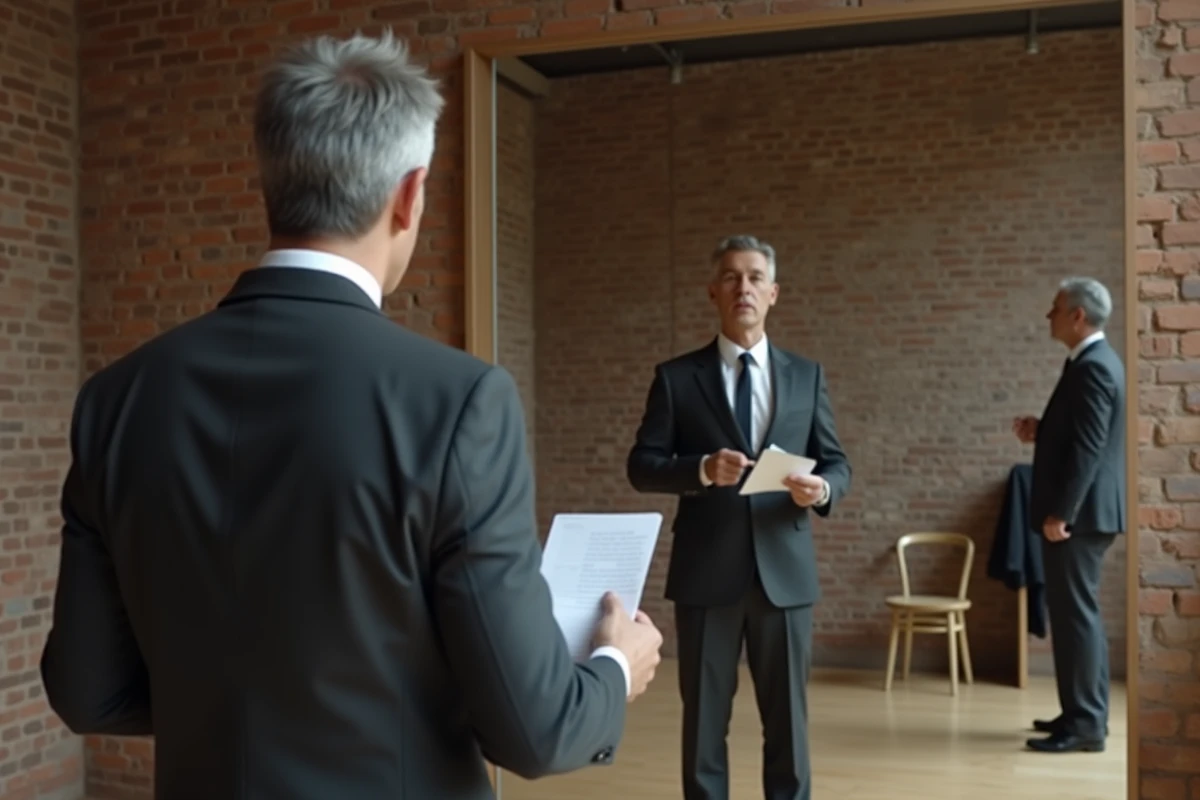
The majority of professionals rehearse their presentation mentally or in front of a mirror. Both methods share a common flaw: they do not allow for the observation of one’s own disruptive habits (speech tics, repetitive gestures, gaze avoidance).
Filming oneself in real conditions remains the most reliable way to improve. The exercise is uncomfortable, but it reveals in minutes what hours of mental rehearsal will never show. We recommend filming at least one full rehearsal for each high-stakes intervention.
Video analysis should be targeted. Rather than correcting everything at once, focus on a single parameter per session: managing pauses during one rehearsal, eye contact during the next, clarity of transitions during a third. This gradual approach avoids cognitive overload and produces lasting corrections rather than superficial adjustments.
Public speaking is developed like any technical skill: through analysis, structured repetition, and adaptation to context. Hybrid formats have made this requirement more visible, not more difficult. Film, analyze, adjust a parameter, repeat. The rest follows.