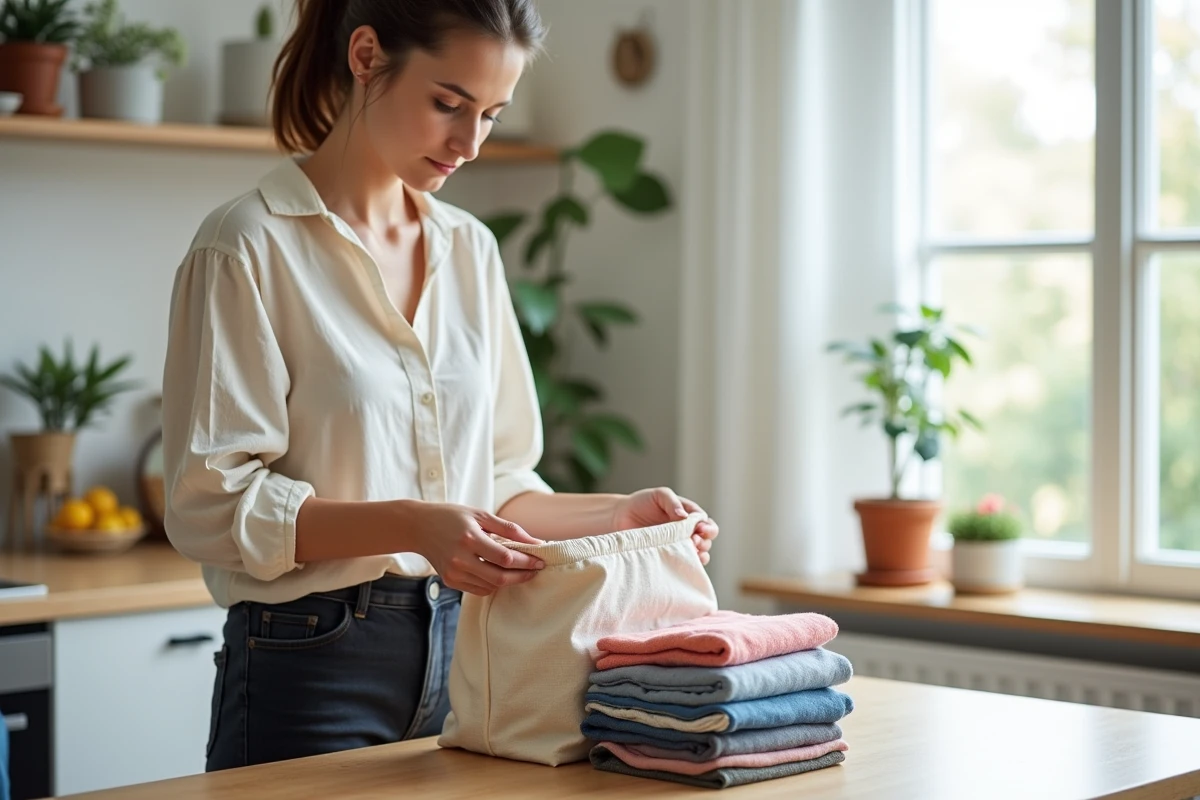
You arrive at the store with a bag of old t-shirts, a pair of torn jeans, and a pair of worn-out sneakers. The question arises: does H&M really accept everything, and what do we actually gain from it? The clothing collection program offered by the Swedish brand deserves a closer look at what happens after you drop off the bag.
What H&M Actually Accepts in Its Collection Bins
The first instinct before heading out is to check what you can drop off. In practice, the collection bins installed in stores accept textiles in any condition: worn, stained, torn. You can also drop off shoes, sheets, or fabric bags.
The brand does not require that the items be from H&M. A Zara sweater, a coat bought at a thrift store, or a tablecloth can be dropped off without any issues. Any textile material is accepted, regardless of the brand.
However, returns vary on one point: wet or chemically contaminated items are sometimes refused. It’s better to drop off dry textiles, even if damaged. You put everything in a bag (plastic or fabric, it doesn’t matter) and hand it to the staff at the checkout or in the dedicated bin depending on the store layout.
To fully understand how the clothing take-back program at H&M works, it’s important to know that sorting does not take place in-store but in specialized centers managed by an external partner.
In-Store Discount: How the Textile Voucher Works

Each bag dropped off entitles you to a discount voucher that can be used in-store or online. This voucher applies to a future purchase, usually on a selection of products. The amount and conditions vary depending on the periods and ongoing campaigns.
One voucher per bag dropped off, within the limit set by the store. Some brands cap the number of vouchers that can be used per day or per checkout visit. You cannot indefinitely accumulate drop-offs to get a massive discount on a single order.
In practice, this system encourages a new purchase. It’s a commercial lever embraced by H&M: the collection of used textiles partially finances recycling while generating traffic in-store. We know this, and it doesn’t detract from the usefulness of the gesture to reduce the volume of clothing that ends up in landfills.
Textile Recycling: What Really Happens to the Dropped-Off Clothes
Once collected, the textiles are sent to sorting centers. There, there are three possible destinations depending on the condition of the items:
- Wearable clothing is resold second-hand, often through charities or export channels to other markets
- Textiles that are too worn to be worn are transformed into recycled fibers, used in the production of industrial rags or insulation
- Non-mechanically recyclable materials are directed towards energy recovery, a last resort solution
The majority of collected textiles are reused or recycled into fibers. The portion that ends up in energy recovery remains minor, but it exists. Textile recycling is still limited by the composition of the clothing: a cotton-polyester blend is significantly more difficult to recycle than 100% cotton fabric.
This is where the real limit of the circular economy in fashion lies. Mixed fibers, which are omnipresent in fast fashion, complicate sorting and reduce the quality of the recovered materials.
Alternatives to H&M: Le Relais Bins, Charities, and Municipal Collection
H&M is not the only option for responsibly disposing of your clothes. Before making the trip to the store, you can compare with other collection channels.
- The Le Relais bins, present in most French municipalities, accept clothing, shoes, and household linen in good or worn condition
- Charities like Emmaüs or Secours populaire prioritize clothing in decent condition for resale
- Municipal collections organized occasionally by town halls allow for the drop-off of large volumes
- Some competing brands (Uniqlo, Kiabi) also offer in-store take-back programs
The choice depends on the condition of the clothing and the proximity of collection points. For items that are still wearable, charities remain the most direct route to reuse. For heavily damaged textiles, the Le Relais bins or H&M collection accept what charities often refuse.
Responsible Consumption: Dropping Off Is Not Enough
Dropping off a bag of used clothing solves the overflowing closet problem. It does not solve the issue of textile overproduction. In-store collection functions as a safety net, not as a structural solution.
Reducing your consumption of new clothing remains the most effective lever. Buying less, choosing recyclable materials (cotton, linen, wool), avoiding synthetic blends that complicate recycling at the end of life: these choices weigh more than the act of dropping off.
Textile recycling does not compensate for constantly increasing production. The model of circular fashion only works if the quantity of clothing produced and purchased decreases in parallel. Without this reduction at the source, collection and recycling channels remain saturated.
The H&M program has the merit of making the gesture simple and accessible. You enter, drop off, and leave. For this gesture to have a real impact on the textile industry, it needs to be part of a broader habit: buying second-hand, repairing, donating to local charities before throwing away. The bag dropped off in-store is just one piece of the puzzle.